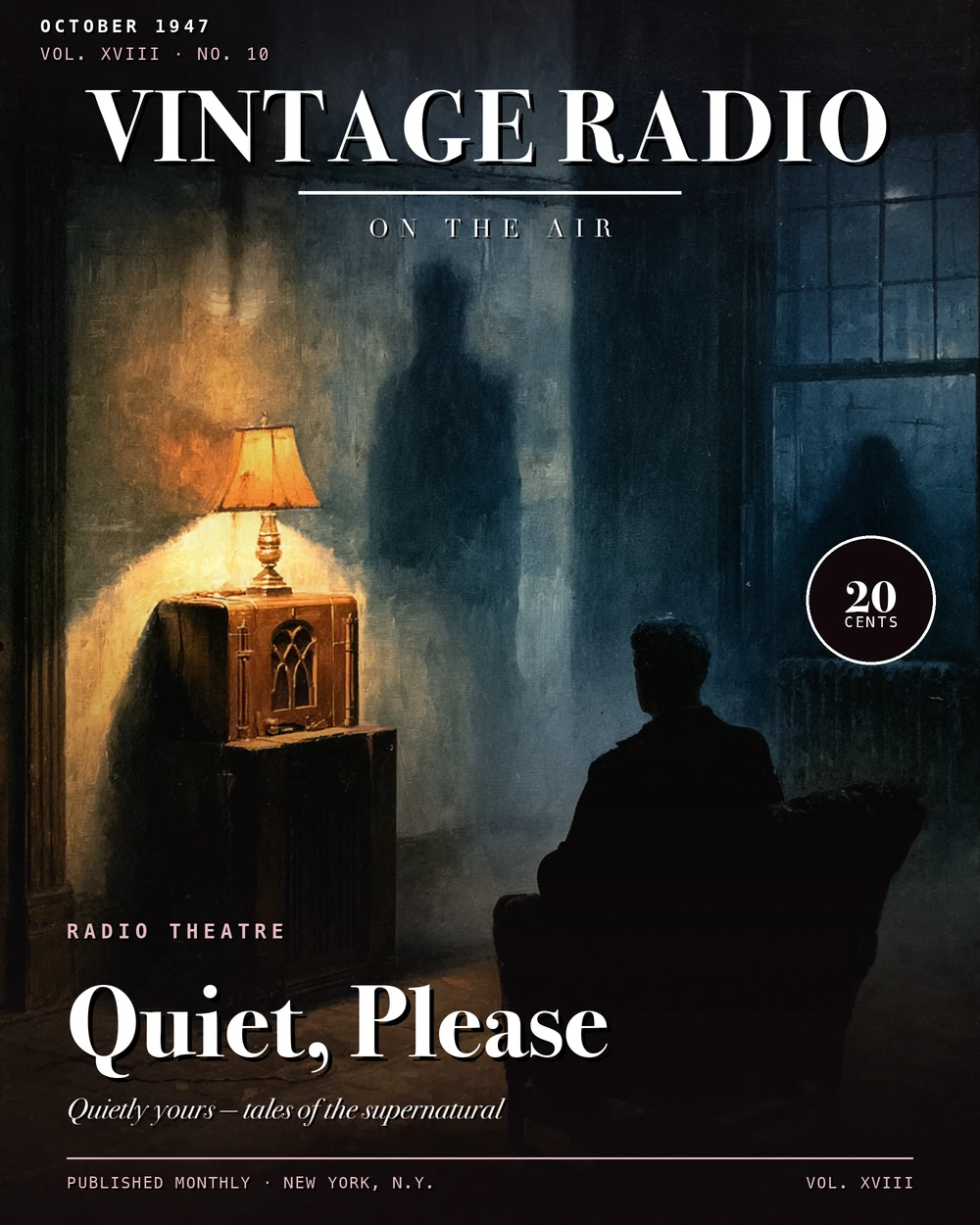
Quiet, Please
The Man Who Built It Twice
Wyllis Cooper had already changed American radio once before Quiet, Please ever went on the air. Born Willis Oswald Cooper in Pekin, Illinois, in 1899, he joined the Signal Corps in 1917, was sent to France during World War I, and was gassed at the Meuse-Argonne Offensive before mustering out in 1919. By the late 1920s he was writing advertising copy in Chicago, and that work led him into radio by way of the NBC program Empire Builders, sponsored by the Great Northern Railway. He served as continuity editor at CBS Chicago, then jumped to NBC Chicago in the same role, and in 1934 he created Lights Out — a horror anthology that became a fixture of late-night broadcasting. He handed it over to Arch Oboler in 1936 and went west to Hollywood. Oboler built a career on that macabre foundation and became a household name. Cooper, meanwhile, wrote some films — including Son of Frankenstein and two of the Mr. Moto pictures — produced a patriotic wartime series called The Army Hour, and toiled in relative obscurity while his creation made someone else famous. Around 1940 he respelled his first name from Willis to Wyllis to please his wife's numerological inclinations, and it was under that spelling that he returned to New York and to radio drama.
That return ran through The Campbell Playhouse, the sponsored continuation of Orson Welles's Mercury Theatre on the Air. Cooper wrote for its final season, collaborating with John Houseman on scripts, and the show's announcer was a man named Ernest Chappell. The two became friends. Seven years later, that friendship would become the engine of Quiet, Please.
The show premiered on Mutual on June 8, 1947, ran until September 1948 on that network, and then moved to ABC, where it continued until June 25, 1949. It was, by its own contemporaries' account, "unsung and little-heard in its day" — which makes it one of those strange cases where a show's reputation has outlasted its actual audience. Cooper never got the recognition Oboler did, and one of his known irritations was having Quiet, Please compared with Lights Out by people who only remembered Oboler's name attached to it.
How It Sounded
The approach Cooper brought to Quiet, Please was almost the opposite of horror-radio convention. He had no interest in theatrical dramatics. His pet hate was what he simply called "acting" — the kind of stylized, portentous delivery that radio horror often leaned on. What he wanted instead was something closer to a man sitting down and telling you, plainly, what happened to him. A deadpan sense of "here's how it happened," as Cooper put it.
Ernest Chappell was the vehicle for that approach. Chappell had been primarily an announcer before this, but Cooper gave him the chance to act, and he proved versatile in accent and delivery. He told every story in first person — sometimes in present tense, sometimes in flashback — playing what Cooper described as some "ordinary fellow who gets all bollixed up with the supernatural." Week after week, that was the premise: a regular person, nothing special about him, pulled into something that defied any ordinary explanation. Chappell closed each episode with his own sign-off: "I'm quietly yours, Ernest Chappell." It was a small, dry grace note that suited the show's sensibility entirely.
Cooper kept supporting casts thin — most plays ran on Chappell alone, or with one or two other voices. Albert Berman provided an eerie piano-and-organ score, drawing on the Second Movement of César Franck's Symphony in D minor for the show's theme; Bill McClintock handled sound effects. The recurring supporting players included J. Pat O'Malley, who appeared in more than a dozen episodes starting with the very first broadcast, and Claudia Morgan — radio star, the long-running Nora Charles on The Adventures of the Thin Man, and Chappell's real-life wife — who turned up regularly in tragic romance roles. Morgan appeared in the series finale, which was itself titled Quiet, Please, a meditation on war and peace; her father, actor Ralph Morgan, appeared in at least one (now-lost) episode as well. That spare approach meant the scripts had to carry more weight, and generally they did.
The Stories Cooper Told
Radio Life described Cooper's scripts as beginning "as immediately and forcefully as opening a door on a madman's monologue," which captures something real about how his stories worked. There was no preamble. You were inside the situation before you'd quite settled in.
The episode Twelve to Five put a disc jockey alone in a radio studio during his overnight request show, visited by a dead colleague. Cooper backed that story with a steady stream of popular recorded music, and the effect was something he may not have entirely planned: the Mutual switchboard jammed with callers requesting the songs they'd heard during the broadcast. The supernatural story and the musical wallpaper had worked together in a way that blurred the line between the play and its medium.
Let the Lilies Consider gave flowers the ability to think and speak, and built something chilling out of their love for humanity. Another episode followed a midget who used a magic wishing ring to become a giant, and found a strange fate waiting for him on the other side of that wish. Whence Came You? took an archaeological dig and ended it with a frightening resurrection of hawklike gods of antiquity. These were not stories that followed a template. Cooper's characters existed in a fuzzy dream world where menace was ever-present — not always violent, sometimes almost tender, but never safe.
The Thing on the Fourble Board
One episode has come to stand above the others in how it's remembered. The Thing on the Fourble Board, broadcast August 9, 1948, put a crew of oil-well drillers on a platform inhabited by an invisible creature from a stony world two miles underground. It has been called "a classic shocker" and described as "as terrifying as anything the radio medium has produced." That holds up as a measure of what Cooper could do when the concept and the execution aligned, and Cooper drew on his own working life — he had spent time in oil fields and on the railroads — for the kind of occupational detail that makes the platform feel like a real place before the horror arrives.
The episode's final moment belonged to actress Cecil Roy, who gave voice to the creature — an invisible thing that had never spoken until that last beat. Her vocal is barely recognizable as human, and the choice to hold that revelation until the end was exactly the kind of structural decision that separated Cooper's best work from formula horror. The payoff arrived out of nowhere and changed the meaning of everything that had come before it.
Radio Life said of Cooper that he "takes liberties with stories whose payoffs are out of this world." That was meant as a compliment, and it describes the essential quality of the show: the destinations were unexpected, and reaching them felt earned.
How He Closed Each Show
Cooper had one more weekly ritual that said something about his personality. At the end of each broadcast, he would tease the following week's play himself — usually unrehearsed, without a script, and often with a grimly humorous undertone. It was an odd choice for a horror program, this unscripted, slightly wry preview from the creator himself, and it gave Quiet, Please an informal quality that set it apart from the more formally produced anthologies of its era.
The show moved through several time slots over its two-year run. On Mutual it started on Sundays at 3:30 — a slot typically reserved for children's programming, which fit Cooper's adult horror about as poorly as scheduling can — then shifted to dual broadcasts on Mondays and Wednesdays by late July 1947, then consolidated to a single Monday broadcast at 9:30 from February 1948 onward. On ABC it ran Sundays at 5:30 before moving to Saturday nights at 9. None of those slots were the kind of prime real estate that guaranteed a wide audience, and the show never attracted a commercial sponsor across the entire run; it aired as a sustaining program from start to finish.
The industry did notice, even if the audience didn't. The American Schools and Colleges Association awarded Quiet, Please its 1947 prize in the dramatic category, alongside the Theatre Guild of the Air, based on a poll of more than 150 educational and civic leaders. CBS executive Davidson Taylor expressed interest in acquiring the show in a March 1948 memo, though the network move eventually went to ABC. A May 1949 Writer's Digest article by Harriet Cannon reported that ABC was receiving more requests for Quiet, Please scripts than for any other show on the network, and announced a forthcoming anthology of those scripts — a book that, in the end, never appeared.
What It Became
Cooper made a few television attempts after Quiet, Please — productions called Volume One and Stage 13, neither of which succeeded, plus contributions to TV versions of Escape and Lights Out — and one more radio series, the 1951–52 NBC crime anthology Whitehall 1212, dramatizing cases from Scotland Yard's Black Museum. He died in 1955 at fifty-six.
The show's reputation grew slowly. Harlan Ellison cited Cooper as an influence and described Chappell's voice as "one of the great radio voices. A sound that combined urbanity with storytelling wisdom." Rod Serling found Cooper's episode One for the Book so close to Richard Matheson's Twilight Zone teleplay The Last Flight that he called it "almost a twin," and tried unsuccessfully to track Cooper down to buy the rights; Cooper's Quiet, Please episode The Pathetic Fallacy was later identified as the source of the Twilight Zone episode From Agnes, With Love. Arch Oboler himself, looking back, credited Cooper as the originator of original radio drama, writing that "radio drama (as distinguished from theatre plays boiled down to kilocycle size) began at midnight, in the middle thirties, on one of the upper floors of Chicago's Merchandise Mart. The pappy was a rotund writer by the name of Willys Cooper."
For decades most of the series was thought to be lost, until recordings of the majority of the 106 episodes resurfaced in the late 1980s; the show is now believed to be in the public domain. The first full-length scholarly treatment came in 2006, when Professor Richard J. Hand devoted a chapter — "The Unsettling Universe of Wyllis Cooper and Ernest Chappell: Quiet, Please (1947–1949)" — to the series in Terror on the Air! Horror Radio in America, 1931–1952 (McFarland), the first book-length academic study of American horror radio's golden age. Hand argued that Cooper and Chappell "created works of astonishing originality" and established Cooper "as one of the greatest auteurs of horror radio."
The show has had a quiet afterlife in performance, too. In 2004, director Corey Klemow staged live adaptations of The Thing on the Fourble Board and Whence Came You? at the Sacred Fools Theater Company in Los Angeles. A film adaptation of The Evening and the Morning exists. And since 2020, the Quietly Yours podcast has been working through each episode in order of original broadcast — a slow, episode-by-episode reckoning with a show that, more than seventy years on, keeps finding the listeners it didn't quite reach the first time.